Archive | February 2012

Are these guys serious?

Marussia will mis the last pre-season test, after their car failed the last of the FIA’s mandatory crash tests. That means the team will arrive in Australia (assuming they can correct the issue and pass the test) with absolutely no mileage on their car.

Driving a Formula One car is dangerous at the best of times. The acceleration, braking, and corning abilities of the cars are staggering. The very idea of participating in a session on a grand prix weekend in a car that has never hit the track is ridiculous. At best, the car will be slow. At worst, it is a death trap.

A slow Formula One car is about the most dangerous thing imaginable. The closing speeds of the cars under braking are mind-blowing. A Red Bull could be braking 80 metres later than a Marussia in Melbourne in three weeks time. The potential exists for accidents like that of Mark Webber at Valencia in 2010, where he ran into the back of Kovalainen’s Lotus because he was surprised by how early the Lotus had to brake.

This is not the first time that a team is arriving at the first race with no testing. HRT have done it for the last two years. In 2010, they ran their cars for the first time in qualifying for Bahrain. In 2011, with the 107% rule re-introduced, they failed to qualify for Australia, to the surprise of no-one.

The regulations do not require a car to run in testing before it can take part in a grand prix weekend. In that regard, the regulations are woefully indequate. The FIA needs to wake up and realise that, by allowing this to happen, they are deliberately creating an unsafe environment for racing. Formula One is dangerous enough already. Why make it worse?

About these ads

Last test coming up

12 Formula One teams will be in Barcelona in the first week of March, for the final four day pre-season test of 2012. It will be the first time that all 12 teams run their 2012 cars at the same time.

We can look forward to two more launches as HRT and Marussia reveal their 2012 challengers to the world. It will be the first time HRT take part in a pre-season test with their current car. They were in Jerez a few weeks ago, but with their 2011 car.

The up-coming test should see the return of Lotus, who pulled out of last week’s test after identifying an issue with their chassis. After a week or so back in the factory, they should be good to go.

In terms of what the teams are likely to be testing, there should be upgrades on some of the cars. Often the teams will start testing with a fairly basic car, and then bring a significant upgrade to the last test in preparation for the first race. So there could be some slightly different looking cars. Any changes to exhausts will be followed closely by all of the teams. Although it is no longer legal to run the exhaust through the diffuser, the teams have now learned that exhaust gases can play a part in producing downforce. Some teams will doubtless be testing exhaust-related solutions on their cars.

There should be quite a few race simulations. Now that reliability issues have mostly been resolved, the teams will want to concentrate on tyre and fuel management over long runs. Performance over long runs will be interesting to watch, as the teams start to find the performance in their cars. Pitstop practice could become more common, as the pit crews fine-tune their skills in anticipation of the start of the season. We will hopefully see some qualifying simulations. Although the teams will not want to give away too much of their true pace, they will also want to gather as much data as they can about low-fuel setups.

The pecking order will only become clear in Australia. In qualifying, we will find out who is the fastest. In the race, we’ll find out who has the best all-round package. Until then, we can only speculate.

Fit for Formula 1

Barcelona F1 Test 20-24/02/12

The G-forces involved in driving an F1 car are far beyond anything an average person will ever experience. Under braking, drivers can be subjected to as much as 5G. Lateral forces in high-speed corners commonly exceed 3G. As a way of translating these numbers, the maximum braking force of a road car is around 1G. So if you’ve been braking as hard as possible on a good surface on a warm day with tyres in good shape and ABS fitted to your car, you might have felt about a fifth (at most) of the braking force of a Formula One car. If you brake as hard as possible in an F1 car, your lungs will be pressed up against your ribs by the G-forces, and the tears will be pulled out of your eyes.

If an average person were to drive a Formula One car – assuming the necessary skill, which is unlikely – the G-forces involved would probably overcome the body’s ability to cope within no more than a few laps. The toll on neck, shoulders, arms, etc. would make turning the steering wheel impossible. The forces involved in accelerating and braking would literally hinder breathing. It doesn’t look physically taxing on TV, but it’s just about the most demanding exercise possible, short of flying a fighter jet or a space-craft.

So Formula One drivers keep fit. And not just reasonably fit. They all spend a good part of each day in the gym, doing exercises that make it possible to withstand enormous G-forces for extended periods of time. Grand prix regulations specify a maximum race time of 2 hours. A practice session is no more than 90 minutes. So you might expect drivers to train to be able to drive for up to 2 hours, which really does sound long enough.

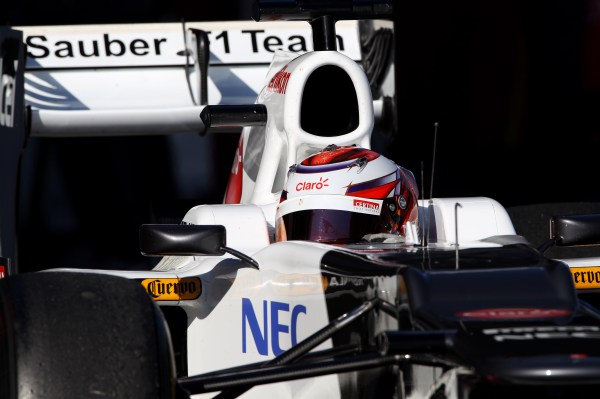
Today, Kamui Kobayashi drove his Sauber C31 for 145 laps of the Circuit de Catalunya in Barcelona, Spain during testing for the 2012 season. Each lap of the track is 4.655km. That’s a total of approximately 675km. If he had driven that far from Barcelona on the road, instead of the race track, he could have ended up in Lausanne, Switzerland. Starting in Cape Town, South Africa, he could have made it to within 100km of the Namibian border. In a Formula One car. A grand prix distance is approximately 305km. Kobayashi did that twice, and another 65km, in one day. The fitness required to do such a thing is almost beyond imagination.

Kobayashi is not the only driver able to cover such distances. Nico Rosberg of Mercedes covered 139 laps today. Pastor Maldonado of Williams drove for 134 laps. Three other drivers were on track for more than 100 laps. At the age of 43, Michael Schumacher drove his Mercedes yesterday for 127 laps. Any one of the 24 drivers contracted to race in 2012 would do the same mileage again tomorrow if required.

It often looks on television like driving an F1 car is easy, boring even. The casual viewer sees speed, glamour, wealth and fame, but often misses the gruelling and constant physical assault a Formula One car unleashes on a racing driver. They may seem like rich playboys who like to mess around on a race track on Sunday afternoons, but F1 drivers are probably the fittest sportsmen on Earth.

First Barcelona Test – Day 4 – Live Commentary

It’s the last day of the first Barcelona test. Follow the live Autosport.com text commentary:

http://live.autosport.com/commentary.php/id/442

First Barcelona Test – Day 3 – Live Commentary

Autosport.com’s live text commentary is riveting as ever:

http://live.autosport.com/commentary.php/id/441

Follow

Get every new post delivered to your Inbox.

Join 297 other followers

%d bloggers like this: